

Theory of Change (ToC)
In impact due diligence, SIIFIC applies systems thinking to understand social and business change as a chain of causal relationships. Through this approach, we conduct a structural analysis of the environment surrounding the portfolio company and identify the “leverage points” that can drive system change. The strategies and narratives that emerge from this analysis form the basis of our Theory of Change (ToC), which sits at the core of our Impact Measurement & Management (IMM) practice.
A Theory of Change visualizes how and why the desired change is expected to occur, articulating the gap between the current state and the intended future state. It serves as a tool for planning how an organization or initiative generates change, evaluating the effectiveness of its actions, and communicating the change process to stakeholders. In this sense, a ToC functions as a compass – continuously refined as activities evolve.
The following related concepts and case studies illustrate how SIIFIC develops and applies ToCs within our investment approach.
#Leverage Points
The concept of “leverage points” was introduced in 1999 by environmental scientist Donella Meadows, author of the well-known essay “The State of the Village Report” (often summarized as “If the world were a village of 1,000 people”). In her seminal work “Leverage Points: Places to Intervene in a System,” Meadows describes leverage points as locations within a system where a small, well-designed intervention can produce disproportionately large and lasting change.
She emphasizes that the most powerful leverage points are not numerical adjustments or short-term tweaks, but the deeper structures of a system – its rules, information flows, and underlying mindsets and paradigms. Intervening at these higher-order points enables more transformative and sustainable impact.
For investors, engaging at these levels expands the potential not just to improve capital efficiency, but to catalyze meaningful and enduring system change.
#Case Study: Proximar
During impact due diligence, SIIFIC applies systems thinking to conduct a structural analysis using a systems map, identifying the “leverage points” capable of driving meaningful change. Building upon these leverage points, we develop a Theory of Change (ToC) that anchors both our investment decision and our post-investment support. Proximar, a company engaged in land-based Atlantic salmon aquaculture, offers a concrete example of this process.
A critical insight in Proximar’s assessment was the causal relationship between the company’s activities and “social capital”—one of the leverage points defined by the SIIFIC Wellness Fund. Through detailed analysis of regional challenges in Oyama Town, Shizuoka Prefecture, including issues related to work opportunities across gender and age, the systems mapping revealed a strong connection between employment and the enhancement of social capital.
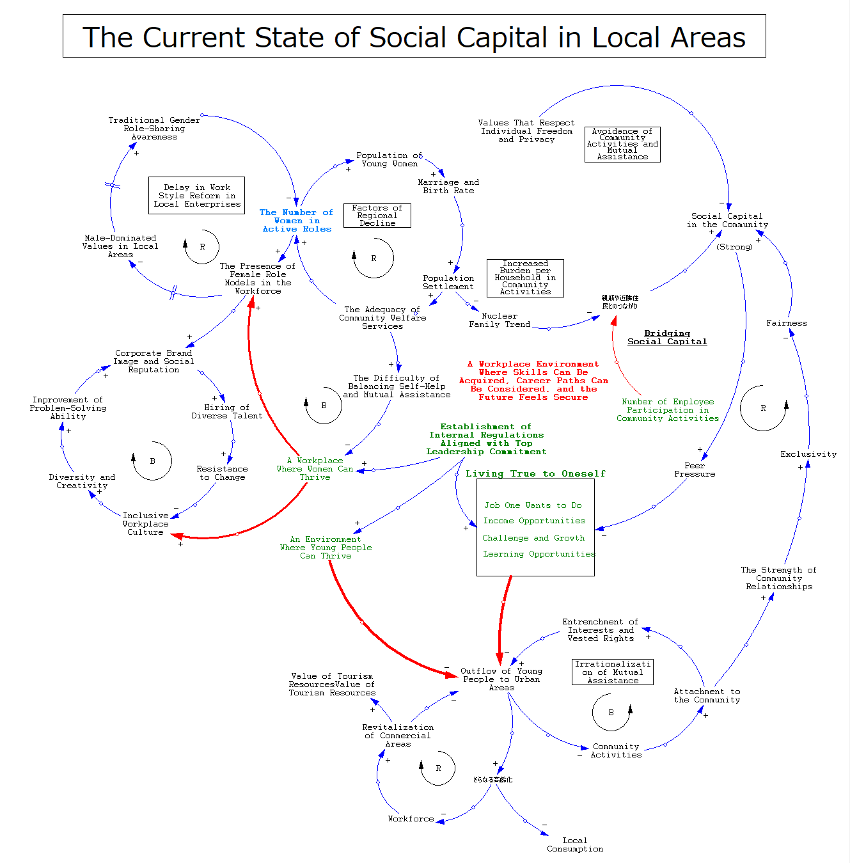
The systems map places particular focus on the element positioned in the upper-left corner: “delayed workstyle reform among local companies.” In many regional areas, women lack access to meaningful job opportunities and have few role models they aspire to become. As a result, young women leave the region. With limited opportunities for youth overall, young people of all genders also move away, accelerating population aging and reducing the community’s ability to sustain local activities. These dynamics weaken the region’s social capital.
This analysis suggests a hypothesis: that workstyle reform among local companies could in fact serve as a leverage point for strengthening social capital. By creating environments in which young people and women can pursue fulfilling careers while continuing to live in their hometowns, residents may develop a stronger sense of attachment to the region. This, in turn, can revitalize community activities and enrich the network of relationships that constitute social capital.
Turning to Proximar, we see real-world conditions that reinforce this hypothesis: that high-quality employment in regional areas can enhance social capital. Proximar is a Norwegian company with advanced aquaculture technology that enables fully land-based Atlantic salmon aquaculture – from hatching to grow-out to shipment – entirely within its facility. Attracted by this cutting-edge technology, people from diverse backgrounds gather to work at the company. Gender distinctions dissolve, and individuals of different nationalities and cultures collaborate freely, with multiple languages audible across the workplace.
Beyond offering roles where employees can directly apply their graduate-level expertise and build their skills, the company provides attractive features such as competitive compensation and the work–life balance typical of Nordic firms, including the ability to take extended leave. These elements together foster an environment where people choose Proximar not because of where it is located, but because of a strong desire to do this work – pointing toward a future in which employees become deeply rooted in the region.
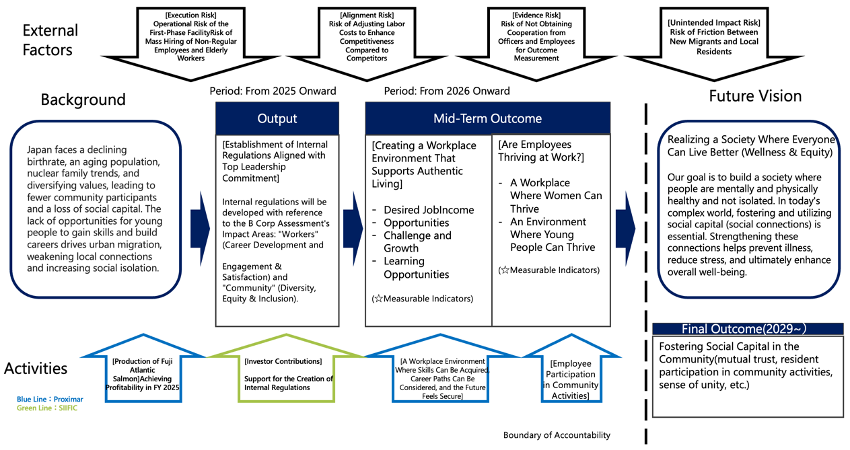
The Theory of Change (ToC) developed through these analyses and discussions illustrates the external factors and contextual conditions surrounding Proximar, as well as the pathway toward the desired future state centered on key leverage points.
In this ToC, the agreed output is the “establishment of internal policies aligned with top management commitment.” This reflects the shared agreement between SIIFIC and Proximar’s leadership to develop employment regulations that create an environment where young people and women can work with vibrancy and autonomy. Although Proximar already demonstrates a strong awareness of community and diversity issues—and is actively engaged in relevant initiatives—its Japan operation is still relatively new and lacks formalized employment policies. For this reason, SIIFIC’s support in developing these policies is explicitly identified as an “investor contribution.”
More concretely, SIIFIC plans to draw on B Corp assessment standards, particularly:
- in the Workers category: “Career Development” and “Engagement,” and
- in the Community category: “Diversity & Inclusion.”
The medium-term outcomes are defined as four components that form the foundation of “living true to oneself”:
- meaningful work,
- income opportunities,
- opportunities for challenge and growth, and
- access to learning.
These serve as the impact KPIs – quantitative indicators that assess how the company’s activities influence society and the environment – and are essential metrics for strengthening social capital. Measurement will be conducted by comparing the results of Proximar’s employee surveys with the Digital Agency’s publicly available Regional Well-Being Index. Through this process, the hypotheses embedded in the ToC will be tested as part of ongoing impact measurement.
#What Makes a Good Theory of Change?
Earlier we described a Theory of Change (ToC) as a tool that visualizes how and why desired change is expected to occur, and clarifies the gap between the current state and the intended future state. Through SIIFIC’s accumulated investment experience and many rounds of dialogue during due diligence, one core question emerged: What makes a good ToC? Our conclusion is simple and decisive: a good ToC is one that moves people.
A ToC that moves people is one that generates insight and emotional resonance among partner companies – sparking new awareness, helping founders reconnect with the passion that drove them at the beginning, and enabling employees to align their work with a clearer sense of purpose and aspiration. When a ToC prompts such shifts in understanding and motivation, it begins to change how people engage with their work and their mission. This emotional and cognitive movement is the very reason a ToC is worth creating.
SIIFIC’s approach is to design a “ToC that moves people” through systems thinking and then translate it into a logic model.